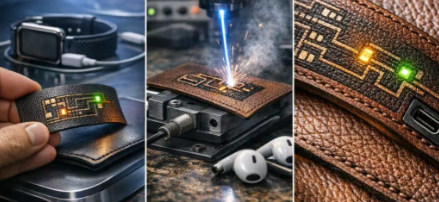
The idea that leather could become a source of energy is no longer the stuff of science fiction. A group of researchers has developed a method that turns the leather of accessories into chargers or flexible micro-supercapacitors. The process, based on a single laser step, allows for the creation of energy storage devices directly on the structure. A sustainable solution, free of toxic materials and designed for next-generation wearable electronics. A step forward toward wearables that power themselves, without traditional batteries.
Transforming the surface of accessories into chargers
As reported by
EurekAlert!, the core of this innovation (developed by a research team at
Jilin University in China) is a laser treatment that modifies the surface structure of the material, transforming it into a conductive network. The beam, calibrated with extreme precision, selectively carbonizes the outer layer, creating a network of microchannels capable of acting as electrodes.
The result is a flexible, thin, and form-fitting micro-supercapacitor capable of storing energy without compromising the leather’s natural elasticity. The strength of the method, however, lies in its simplicity: a single step, no solvents, and no complex chemical processes. Vegetable tanning is an integral part of the process: the composition of the material influences the conductivity and stability of the circuit. In this way, a bracelet, a bag, or a belt can become micro-energy chargers, capable of powering sensors or small electronic devices.
Wearable Electronics
The micro-supercapacitors produced through this process are not only flexible but also highly stable and resistant to repeated bending. While their charge capacity cannot match that of lithium batteries, it’s sufficient to power sensors, micro-LEDs, monitoring systems, and low-power components. Looking ahead, we are talking about a technology that could be integrated into smart textiles, prosthetics, medical devices, and body-machine communication systems. All objects that communicate with each other without the need for bulky, replaceable, or polluting batteries. The skin, from a simple biological interface, becomes even more fertile ground for the energy of the future: a living, dynamic substrate capable of hosting lightweight and sustainable electronics.
Images generated with the support of AI


 京公网安备 11010202009378号