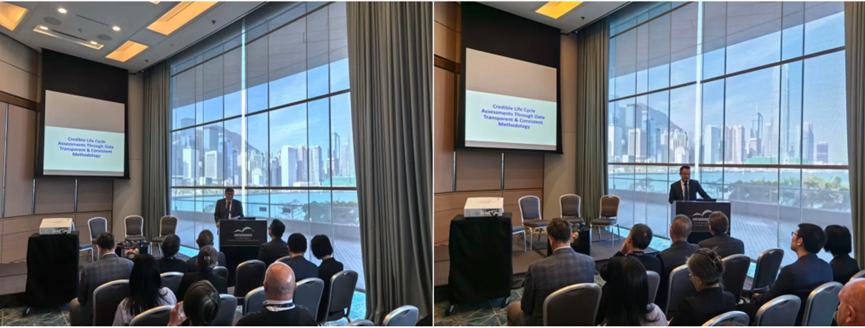
On March 13, 2026, the seminar on interim results
of Leather Life Cycle Assessment (LCA) and carbon footprint accounting,
co-hosted by the Leather and Hide Council of America (LHCA) and the China
Leather Industry Association (CLIA), was successfully held in Hong Kong, China.
At the seminar, Professor Yunhang Zeng from Sichuan
University (China) and Professor Greg Thoma from Colorado State University
(USA) presented their research results entitled “A Case Study on Integrating
Chinese Tannery Data into LCA” and “LCA Methodology & Data Integrity in
Leather Sustainability Assessment”, respectively.
The research results show that the carbon footprint of finished leather
comes from upstream allocation and leather production itself, of which the
carbon footprint generated during the leather production process accounts for
only 4% to 40% of the total, while 60% to 96% of the carbon comes from
allocation of the upstream animal husbandry industry. If there were no leather
industry, most of these hides and skins would have to be landfilled. The leather
industry is the most sustainable way to address global hide disposal and reduce
carbon emissions from the animal husbandry industry, yet the current carbon
footprint proportion allocated to animal hides from animal husbandry industry
is highly unreasonable and unscientific. By reusing hides and skins through
leather making, the global leather industry can reduce approximately 120
million tons of carbon dioxide equivalent emissions annually. The carbon
footprint of hides and skins in the leather making process is only 1% to 9.7%
of that from landfill disposal, and the carbon emissions generated during
leather making are much smaller than those caused by landfilling. Therefore,
the leather industry is a user of animal husbandry industry by-products and a
significant contributor to reducing carbon emissions. CLIA urges that when
allocating carbon footprint to hides and skins, the animal husbandry industry
should fully consider the actual role of leather making in avoiding massive
carbon emissions from landfilling, and thus substantially reduce the allocation
ratio or even allocate no carbon footprint to raw hides and skins.

CLIA will continue to collaborate with LHCA and other international
industry organizations as well as relevant domestic and international
institutions to carry out more work on leather’s carbon reduction contribution
across the entire animal husbandry industry value chain and on achieving a more
reasonable and scientific allocation ratio for raw hides and skins carbon
footprint.


 京公网安备 11010202009378号