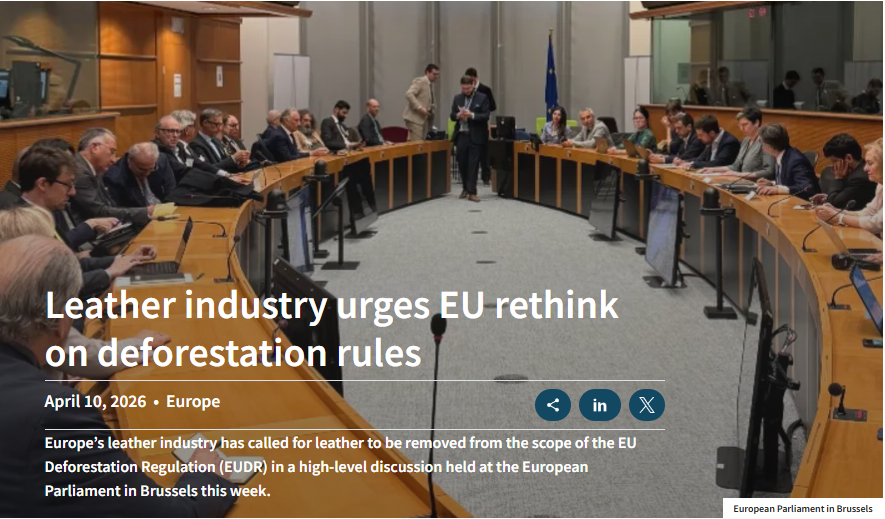
The debate, initiated by Italian MEP Dario Nardella, brought together policymakers, European Commission representatives, scientists, industry leaders and international delegates, as the Commission prepares a Delegated Act to revise which products fall under the regulation by the end of April.
Industry representatives argued that leather has been wrongly included in the EUDR without sufficient impact assessment, stressing that it is not a driver of deforestation. Evidence presented, including research from the Sant’Anna School of Advanced Studies, was cited to support the claim that leather production primarily transforms a byproduct of the meat industry rather than contributing to forest loss.
Key concerns raised during the discussion included the limited financial incentive for farmers to comply with EUDR requirements, given that raw hides represent only around 1.4% of a bovine carcass’s value. Participants also warned that maintaining leather within the regulation could push European production outside the EU, disrupt global value chains and lead to significant waste if hides are not processed.
Speaking at the event, Nardella emphasised the importance of the leather sector to regional economies such as Tuscany, arguing that regulation should focus on industries directly responsible for deforestation rather than those contributing to circular materials.
Fabrizio Nuti, President of UNIC, warned that the current framework risks driving small and medium-sized tanneries out of business while consolidating the market among larger players. Meanwhile, Callie Stewart of the Mission of Canada to the EU noted that compliance costs could discourage exporters from supplying the European market altogether.
There were also signs of flexibility from the European Commission. Luis Planas Herrera, a member of Commissioner Jessika Roswall’s cabinet, indicated that upcoming adjustments to the regulation would aim to balance environmental goals with industrial competitiveness, ensuring that requirements remain proportionate and practical.
The Brussels meeting, organised by Cotance, concluded with a call for evidence-based policymaking ahead of the forthcoming Delegated Act, which is expected to play a decisive role in determining the future regulatory treatment of leather within the EU.


 京公网安备 11010202009378号