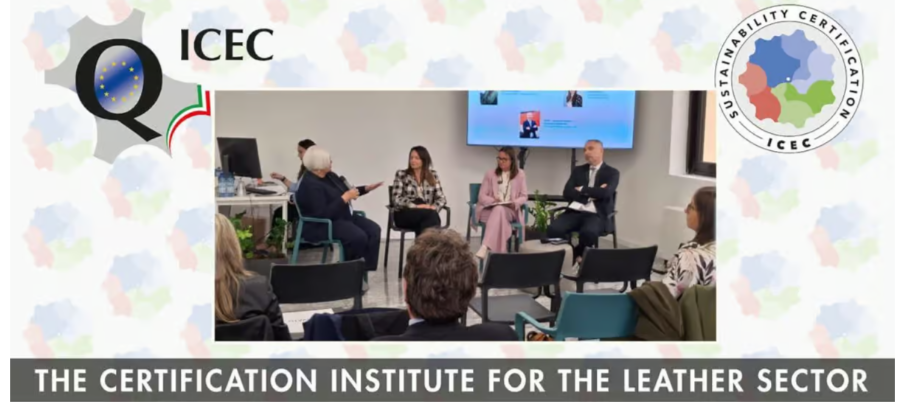
The shareholders’ meeting provided an opportunity to review activities carried out in 2025. The total number of certified companies — mostly based in Italy, with a smaller share operating abroad — has grown by 11%. Meanwhile, staff growth (the number of inspectors has risen from 30 to 32, with a further three currently in training) reflects the expansion in activity volumes. ICEC is consolidating its position and, looking ahead, is relaunching its expansion strategies.
Strategy and challenges
First and foremost, the leather sector’s leading certification body intends to continue along the path “that has seen activities expand from tanneries to chemical suppliers, involving the entire supply chain right up to the brands”, explained director Sabrina Frontini. At the same time, the organisation remains firmly committed to operating “through expertise, in a transparent manner, as an Accredia-accredited body and in collaboration with standardisation organisations”. All this while awaiting greater clarity from lawmakers in a crowded market where competition is “fierce” — to put it mildly — and often redundant for manufacturing companies.
ICEC consolidates its position
These issues were discussed on 14 May in Arzignano, near Vicenza, at MILE (Museum of Interactive Leather Experience) during the ICEC shareholders’ meeting and board session. The operational framework for certification bodies and standardisation activities, explained Emanuele Riva (Accredia) and Stefano Sibilio (UNI), is changing alongside the regulatory activity of the European Union and its global partners. A seismic shift that is gradually moving the sector from the sphere of voluntary action towards that of compliance with mandatory regulations. In the medium term, Riva noted, this will force operators in the sector to rethink their role, “for example by extending it from the current certification of compliance to the drafting of ratings”.
The crowded landscape
Meanwhile, a multitude of operators is crowding the certification arena, complicating B2B relationships and “confusing end consumers”. This was explained by Carlo Brondi, president of ICEC’s Impartiality Safeguard Committee and researcher at the CNR. Protecting valuable certifications also means protecting their role as a competitive advantage. “Only a minority share of companies in the leather supply chain”, Brondi stated, “are certified. But, unsurprisingly, they are also the most internationalised segment”.
The hope, according to Gian Piero Geminiani, legal adviser to UNIC – Italian Tanneries, is that European directives will simplify — in favour of expertise — a framework currently overcrowded with players and methodologies, not always transparent. “How? For example, by clarifying the separation of roles between those qualified to draft certification schemes, those who own them and those who verify their implementation. The direction appears to be this, but the decisive factor is time”.
Market demands
“It is a necessity for the Italian manufacturing fabric”, concluded Giovanna Ceolini, president of Confindustria Accessori Moda and ICEC, “which is made up of SMEs employing on average 10 to 15 people. In a difficult economic climate, these companies bear the burden of certifications while struggling to have their costs recognised by the market”. The harmonisation of a landscape “where many different certifications are applied — however similar and collectively redundant they may be” is also the hope expressed by Laura Vantin, vice-president of ICEC and board member of UNPAC, the association representing manufacturers of chemical auxiliaries for tanning.
In the background of the debate involving attendees at the shareholders’ meeting were certain private certifications operating without coordination with accredited standardisation systems. These schemes use their commercial strength downstream in the supply chain as leverage to gain acceptance upstream as well. It is a distortion of market relationships that requires a systemic response, as well as a more decisive reaction from individual operators.
In the photo, from left: Ceolini, Vantin, Frontini and Geminiani


 京公网安备 11010202009378号