On December 23,
2025, the Final of the 2nd National Vocational Skills Competition for the
Leather Industry (Leather Goods Designer) — part of the 2025-2026 National
Industry Vocational Skills Competition — and the Final of the 25th
"Genuine Leather Mark Award" China International Bags & Leather
Goods Design Competition jointly held and concluded successfully in Huadu
District, Guangzhou Province, known as "Leather Goods Capital of China".
The Final of
the National Vocational Skills Competition for the Leather Industry (Leather
Goods Designer) attracted 140 outstanding participants from six competition
zones: Guangdong, Henan, Hebei, Jiangxi, Zhejiang, and Hunan. Most of them are
technical specialists
from enterprises, teachers and students from professional colleges and
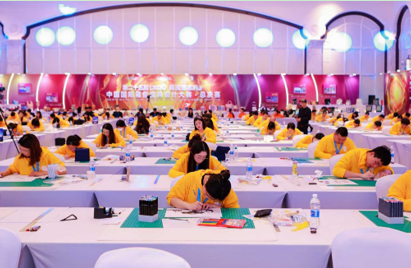
universities, as well as independent designers. The competition consists of two
major parts: a theoretical examination and a practical assessment. The latter,
accounting for 70% of the total score, requires participants to independently
complete the entire process of a leather goods item — from creative conception
and design drafting to full-set structural pattern making — within 240 minutes.
It comprehensively tested their craftsmanship precision, creative feasibility,
and time management capabilities. After intense competition, a group of skilled
talents with solid foundations and innovative potential stood out.
Held
concurrently, the 25th "Genuine Leather Mark Award" China
International Bags & Leather Goods Design Competition, guides the
industry's creative trend through its thematic concept. With "Revitalized
Realm" as the core theme, this year's competition sets two design
directions: "Urban Pastoral" and "New Sky Era", encouraging
participants to explore the harmonious coexistence of natural ecology and
future technology. A total of over 800 works were collected from more than 40
colleges and universities, including Beijing Institute of Fashion Technology
and Donghua University, as well as enterprises and independent designers. After
multiple rounds of evaluation, 79 entries that combined imagination with
technical feasibility advanced to the final round.


 京公网安备 11010202009378号







.jpg)
